

Why culture work needs training
By Britta Matthesius, founder of NOUWORK. Published in htr hotelrevue, issue 11, November 2026.
“Without our team, we would never have won this award.” Sentences like this are often heard in the industry. But how present is this thought in everyday work, when difficult conversations come up, complaints increase and the tone threatens to become harsher? And this at a time when the industry seems to be losing its appeal for employees.
For many, hospitality nevertheless remains appealing: working in beautiful hotels, with a close-knit team and contact with guests from all over the world. But a beautiful working environment alone is not enough. Nor does a long list of benefits answer the fundamental questions. A hotel stays attractive when everyone knows what the shared standard means concretely in everyday work. This shared attitude develops through practice, just like any other skill of the trade.
The code gets lostIn the past, employees learned the processes, the attitude and the tone of a hotel during their apprenticeship and internalised them over the years. This path has become narrower. What is often missing is the time in which a hotel’s code was passed on.
Many businesses find it hard to decode their own code. In daily operations, there is often no time for it. Yet this clarity can make working together easier, from the management team to the employees. In seasonal businesses, there are only five to seven months for this anyway.
The answer is often onboarding. It is meant to show how the business works and what is expected. But pure knowledge transfer falls short: those who only listen adopt the existing rules. When employees are involved, they can better understand the hotel’s values, support them and put them into practice in everyday work.
Values provide orientationValues are the starting point. They convey what a hotel stands for: Excellence, Passion, Family. Three words, as they appear in many mission statements. Excellence is an aspiration, Passion an emotion, Family a metaphor. What matters is what can be derived from them for daily action. What does Excellence mean for housekeeping, and what does it not mean? What does Passion mean in the kitchen? And what does Family mean at reception when a guest raises their voice?
As long as these questions remain open, everyone fills the words with their own experience. Different cultures, languages and backgrounds in one team are part of what makes hospitality appealing, but they are also a challenge. This makes a shared understanding of which attitude and which behaviour are expected in the business all the more important. The task of bringing everyone onto the same page lies with leadership.
Time as a critical factorIn conversations, seasonal businesses in particular described administration as a major burden on their time, in some cases even as a second full-time job. Anyone who spends a considerable part of the day on administrative tasks hardly finds the time to think about what Excellence means in housekeeping, for example. This makes it all the more important to give HR the space it needs. For values to be anchored in everyday work, businesses have to plan time and budget for it.
Between knowing and doingAnyone who rows knows this: the stroke that sets the pace is only taken up by everyone after many repetitions. And even the strongest rower slows down the whole boat if they do not fit in. The same applies to behaviour in the business. Around 40 per cent of everyday life runs on habit. Under pressure, the brain falls back on practised patterns. According to a study by University College London, it takes on average 66 days for a new behaviour to become a habit. Culture work therefore needs training. A single appointment in the calendar is not enough.
The luxury hotel THE OMNIA in Zermatt shows what this can look like. In a values workshop in autumn 2025, the hotel clarified together with leaders and teams what its own values concretely demand in everyday work and what should deliberately be dropped. But such a result does not last on its own, because with every season new employees join who did not experience this process. They have to be involved, and what has been worked out has to be reactivated again and again. Culture work therefore belongs in the operating rhythm, like any other training.
A different startMany hotels know the situation: there was a misunderstanding in the team, or the guest scores are not as hoped. The usual reflex is often an appeal in the briefing or a new standard. A different approach can be for the management team to take one hour for two questions: What does the hotel’s most important value concretely demand in everyday work, and what does it not demand? And could the employees say this tomorrow in their own words? This hour often reveals more about a hotel than many a report.
From the inside outIs hospitality still attractive enough? There is no simple answer. Location, pay, working hours, housing and leadership all play a part; what matters is how they work together. The starting point lies within the business itself. Those who work out their own appeal together with their team change everyday work first, and then how they are seen from the outside. Guests feel this within the first few minutes. Employee experience carries guest experience.
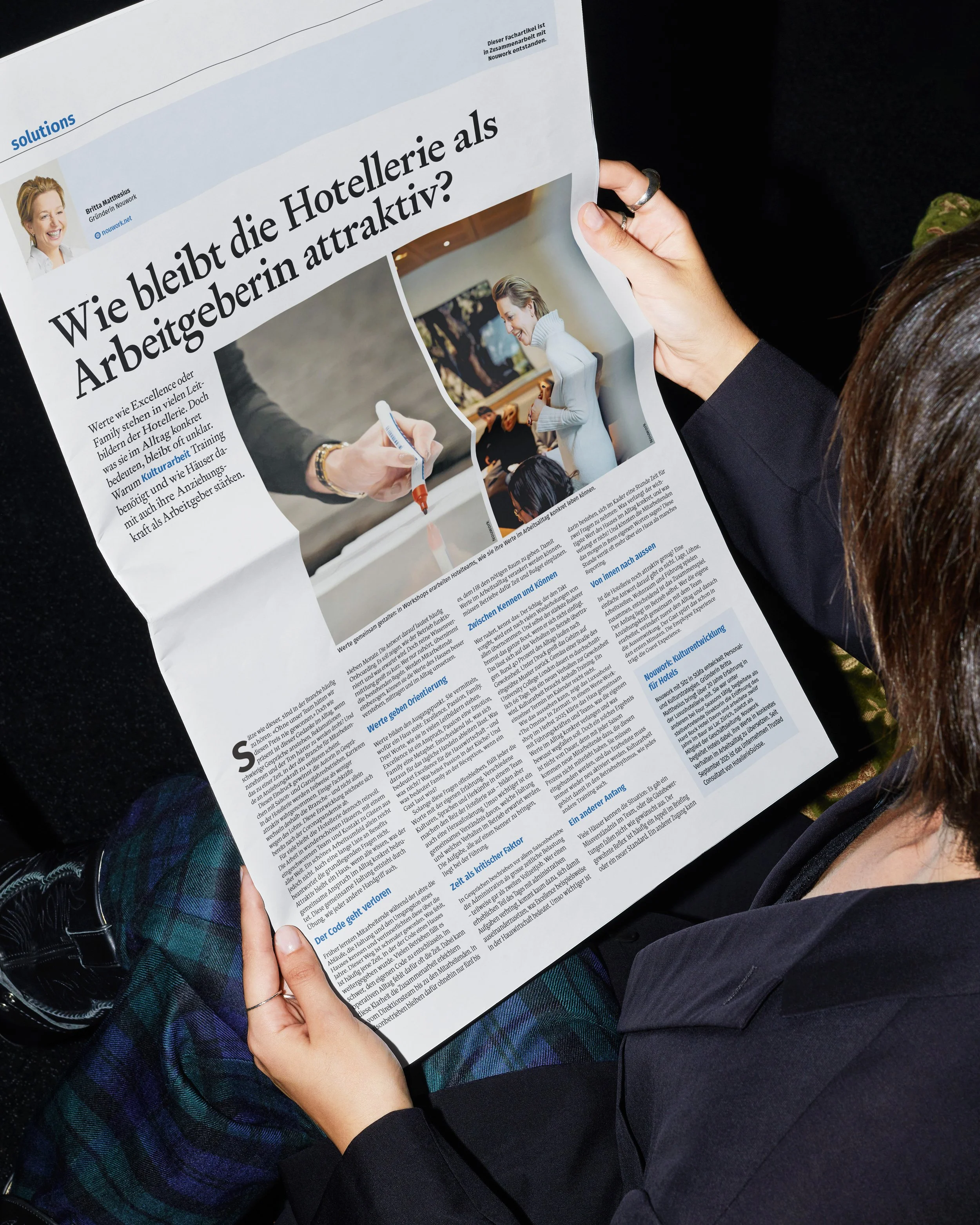
The article in htr hotelrevue, No. 11, November 2026.